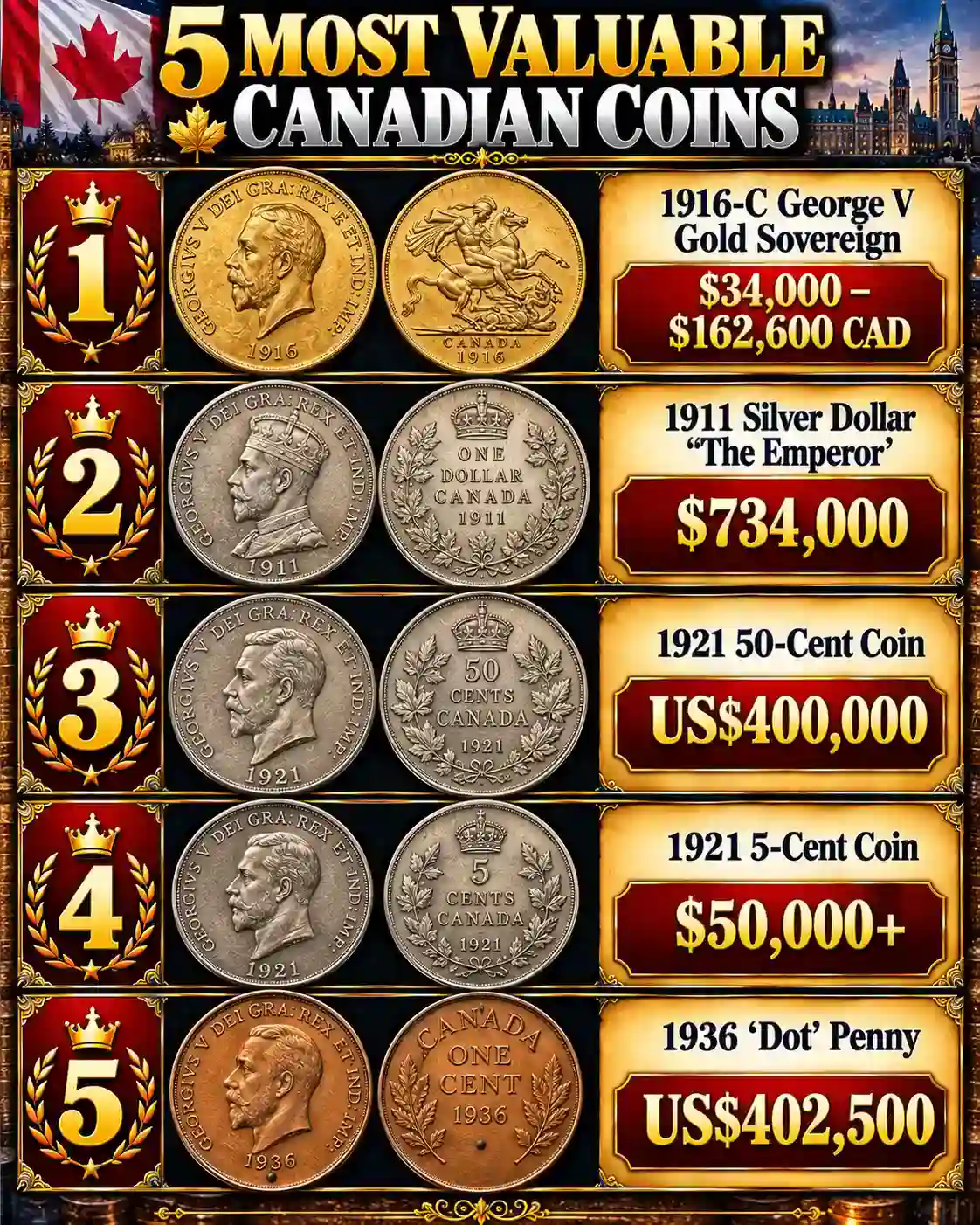
Most of us toss Canadian coins in a drawer and forget about them. But a handful of Canadian coins have sold for more than a nice house, and the stories behind them are as good as the price tags. Some were never meant to be released, some were nearly wiped out by the melting pot, and one carries a tiny dot that tells you a king died. Here are five of the biggest, ranked by the highest sale I could verify, with the details of who sold them, where, and for how much.
A quick note on money: “US$” means U.S. dollars and “C$” means Canadian dollars. Auction prices include the buyer’s fee unless noted.
1. The 1911 Silver Dollar, “The Emperor of Canadian Coins”
Canada passed a law in 1910 allowing a silver dollar, and the Mint struck a few trial pieces in London. Then the government changed its mind and never made the coin. Only two silver examples exist, plus one struck in lead. One silver piece belongs to the Royal Mint Museum and sits on loan at the Bank of Canada Museum in Ottawa. The other is the only one collectors can own. The “Emperor” nickname dates back to a 1976 auction in Toronto, according to the Bank of Canada Museum.
That private coin made headlines twice. In January 2003, it sold at Heritage Auctions as part of the Belzberg Collection, put together by Toronto collectors Sid and Alicia Belzberg. PCGS graded it Specimen 65 then, and it went for US$690,000.
It came up again on August 15, 2019, at Heritage’s Platinum Night sale during the ANA World’s Fair of Money in Rosemont, Illinois, just outside Chicago. This time it came from the George Hans Cook Collection and was regraded Specimen 64. It sold for US$552,000, including a 20 percent buyer’s fee, against an estimate of $500,000. That’s about C$735,000.
This is one of the few cases where we know who bought it. Two Canadian dealers teamed up: Sandy Campbell of Proof Positive Coins in Nova Scotia and Ian Laing of Gatewest Coin in Winnipeg. Their win brought the coin back to Canada.
2. The 1936 “Dot” Cent
King George V died in January 1936, and the Mint didn’t have a new portrait ready. So in 1937 it kept striking cents with the old 1936 dies. To show they were later strikes, a tiny dot was added below the date. Only three Dot cents are known. Mint records claim over 678,000 were made, and nobody has a good explanation for where they went. Collector John Jay Pittman owned all three for decades, and they only returned to the market after he died in 1996.
The best one sold on January 3, 2010, at the Waldorf Astoria in New York, during Heritage’s NYINC auction. It was the star of the Canadiana Collection, which brought in $3.85 million in total. Heritage expected $300,000 to $400,000, and the coin, graded PCGS Specimen 66 Red, closed at US$402,500. The buyer wasn’t publicly named.
That same coin had sold for US$230,000 at the Belzberg auction in January 2003. The other two Dot cents sold for $121,000 in October 1997, and again for $207,000 in January 2004.
3. The 1921 Fifty Cents, “King of Canadian Coins”
Canadians simply didn’t want 50-cent coins in the early 1920s, so most of the 1921 batch sat in storage. In 1929 the Mint melted them. Roughly 75 to 100 survive today.
The top price I found is C$319,890, paid in August 2019 at Heritage Auctions’ Cook Collection sale. The coin was graded PCGS MS66 and came from the Parrino and Norweb collections. The same coin sold again on May 26, 2023, through The Canadian Numismatic Company for C$296,250, about 7.5 percent less. In both cases the buyer’s name wasn’t released.
Other sales show how the market moves. On January 3, 2010, an MS66 sold at Heritage’s Waldorf Astoria sale for US$218,500, which Coins and Canada lists as C$236,650. A different MS66 went for C$277,300 in February 2014 at The Canadian Numismatic Company. Even a worn VG-10 brought C$65,550 in November 2019.
4. The 1916-C Gold Sovereign
During World War I, the Ottawa Mint worked as a branch of the Royal Mint and struck British gold sovereigns with a small “C” for Canada. The 1916 issue had a mintage of just 6,111. Most were probably melted, and collectors think only 40 to 60 survive.
Prices depend heavily on condition. An MS64 sold for a US$34,000 hammer price at Heritage in April 2015. In August 2015, an MS66 brought C$110,000 at Heritage’s Chicago sale. The highest price I found was about C$207,636 in 2019, for a top-grade coin from the Parrino and Cook collections. Later, an MS64 sold for C$54,144 in 2021, and an MS62 for C$30,552 in 2023. None of the buyers were publicly identified.
5. The 1921 Five Cents, “Prince of Canadian Coins”
The Mint made about 2.58 million of these tiny silver coins in 1921. Then Canada switched to a nickel five-cent piece, and almost the entire batch was melted. Only a few hundred are left.
The record sale was in June 2016 at Torex Auction in Toronto, where a PCGS MS67 coin sold for C$165,200. Earlier, on January 3, 2010, an MS67 sold at Heritage’s Waldorf Astoria sale for C$125,750. That same day, the Norweb Collection’s MS66 went for US$69,000 to an internet bidder. Buyers weren’t named in any of these. A heavily worn coin graded Good-4 still brought C$5,378 at the Prominence XIV sale, which shows how much even a rough 1921 five-cent piece is worth.
The Takeaway
Condition matters as much as rarity. A worn 1921 five-cent piece might fetch a few thousand dollars, while a flawless one sells for six figures. And beware of online hype: a regular 1936 Canadian cent is common. Only the one with the dot is rare. If you think you’ve got one of these, get it authenticated and graded by a service like PCGS before you do anything else.