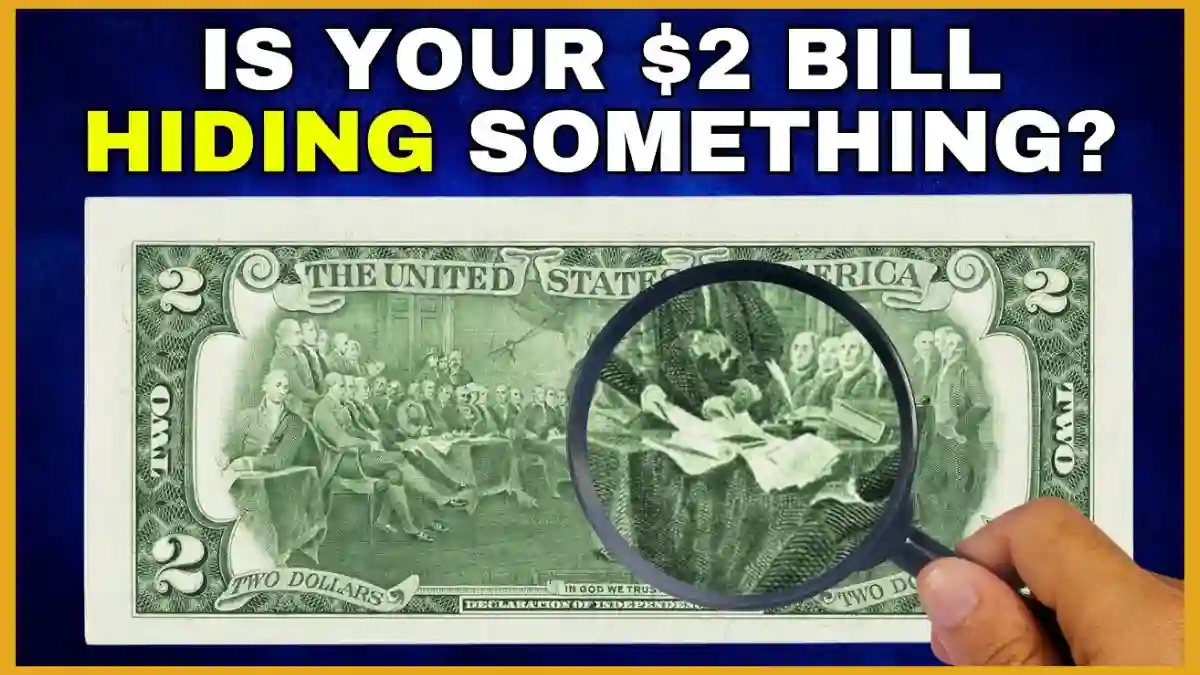
Did you know the United States still produces $2 bills to this day? That’s right, guys. You can literally walk into your local bank and pick up a fresh pack of $2 bills.
My name is James, and I’ve helped collectors buy and sell millions in rare collectibles. Every sale price in this article is backed by real data from top auction houses like Heritage. So sit back, strap in, because this is a great list and you don’t want to miss a single note. Let’s hop right in.
1. 1976 $2 Star Note, PCGS 68 PPQ: $1,150
You may be asking yourself, why would a $2 bill sell for this much money? A lot of people think that when they come across a $2 bill, it’s going to be worth a lot. Heck, I still carry $2 bills around. I give them out as a tip or pay with them at the grocery store, and people usually lose their minds. They think it’s the coolest thing ever. But if you ever came across this bill, you would not want to spend it. Here are the two things that made it worth so much.
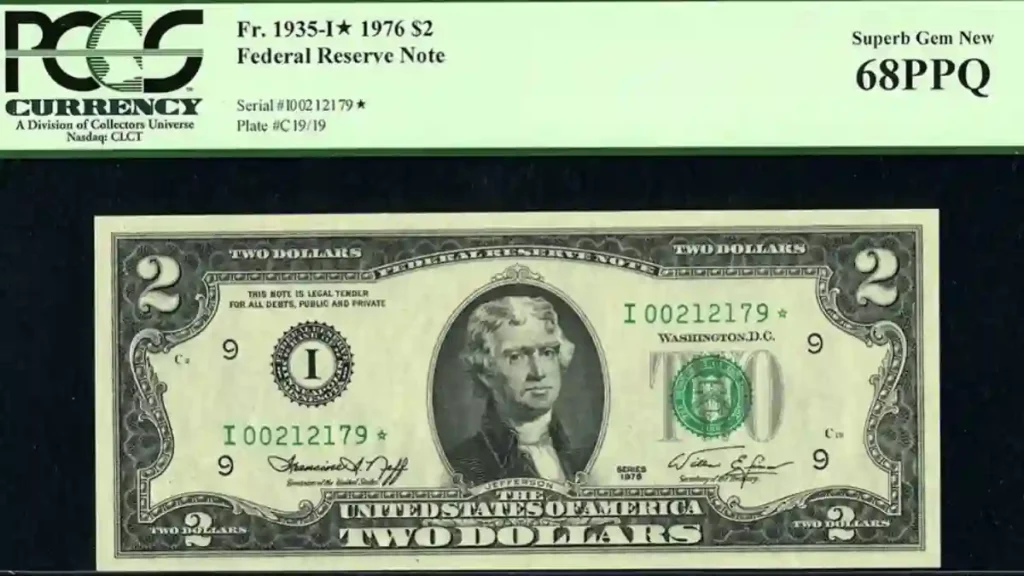
First, condition. I’ll make this quick: condition is incredibly important, because collectors pay more for a bill in better condition. So if you come across a $2 bill, don’t fold it, don’t tear it, don’t get it dirty, don’t stain it. Don’t do anything that will lower its condition. This one was graded a 68 PPQ by PCGS. 70 is the highest grade, so it’s only two points away. More on how to get a higher grade later.
Second, the serial number. Look at the bottom left and the top right. The numbers match identically, which is a good thing. But at the end of the serial number you’ll see a star. That star is very important, because it means this is a replacement note.
Replacement notes are produced during a normal print run at the Bureau of Engraving and Printing. They’re set off to the side and used if notes get damaged during printing, or if there are error notes, which I’ll show you in a bit. So a star note means it replaced a damaged or mistake note. Pretty cool, right? The high grade plus the star replacement is how this note sold for 1,150 bucks.
2. Two Mismatched Serial Number $2 Bills: $2,585 Total
Here we have two $2 bills that sold for a total of $2,585. I wanted to show you these because they’re what we call sleeper notes. These are bills you wouldn’t think are worth a lot of money, and most people don’t have the attention to detail to catch them.
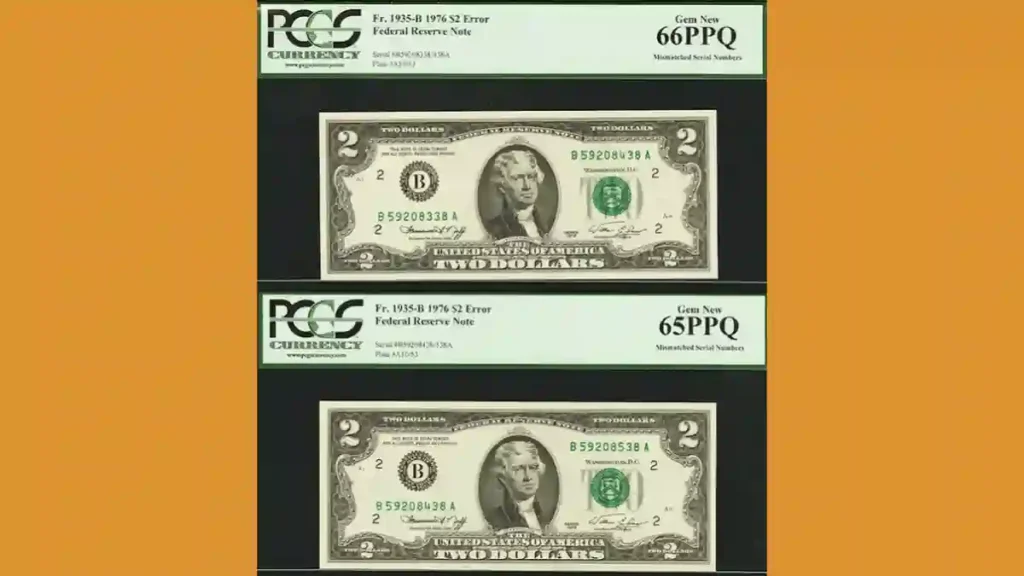
Look at the front and back and everything seems very normal. So pay close attention to the serial numbers. On the top bill, the top right serial number ends in 483 and the bottom left ends in 338. On the second bill, the bottom left ends in 438 and the top right ends in 538. This is what we call a mismatched serial number error, where the serial numbers on the bill don’t match. It’s incredibly rare and incredibly valuable.
And here’s the cool part: you can do this too. Go to your local bank, be friendly to the person helping you, and say something like, “Hey, I was wondering if you had any fresh $2 bills, or if you could order some in.” Then go through those bills very carefully and look for rare ones like the ones in this article.
Worst case scenario, you find nothing rare, and you simply bring the stack back to the bank and return it into your account. So the worst case is you have some fun looking through $2 bills. The best case is you find rare paper money like this. Once again, these two bills sold for $2,585.
3. Offset Printing Error: $2,640
Looking at the front of this bill, you’d wonder why it sold for $2,640. Let me explain the printing process first. The back of the bill is the first print. The front is the second print. The third and final print is the overprint, which is the green seal on the right, the green serial numbers, and the black district seal on the left.
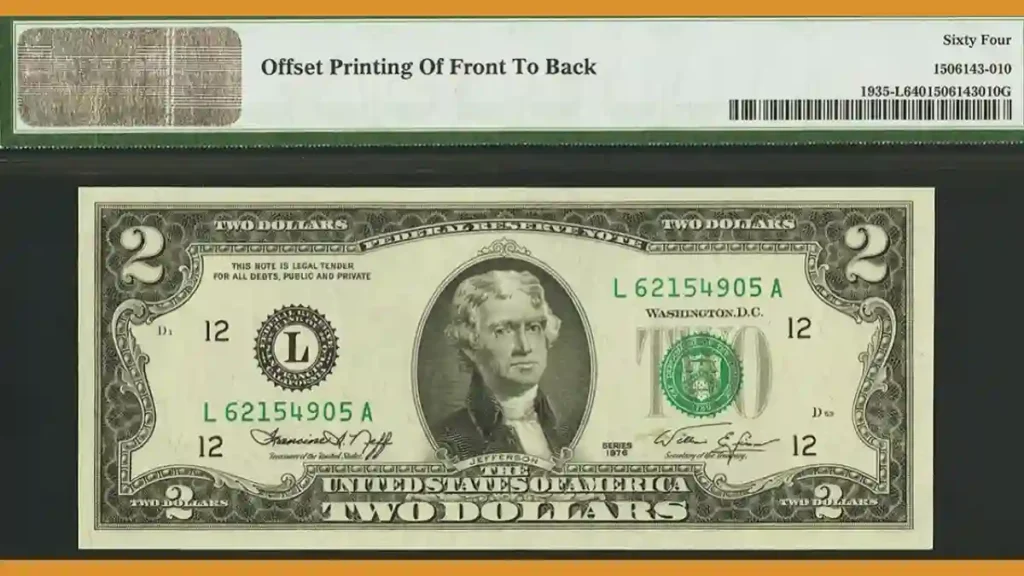
It’s not until you flip the bill over that you see a pretty big mistake. This is an offset printing error. To keep it brief, the machine was printing the second print, but there was no paper in the machine. So the ink came right down onto the plate, and when they did feed the sheets in, it transferred onto the back of the bill. Pretty cool, right? That’s why this one sold for 2,640 bucks.
4. Inverted Overprint: $2,880
Let’s start on the back of this bill, which sold for $2,880. What you’re looking at is the signing of the Declaration of Independence. The scene includes 42 of the 56 signers, with Thomas Jefferson at the center handing the draft to John Hancock, who was the president of the Continental Congress.
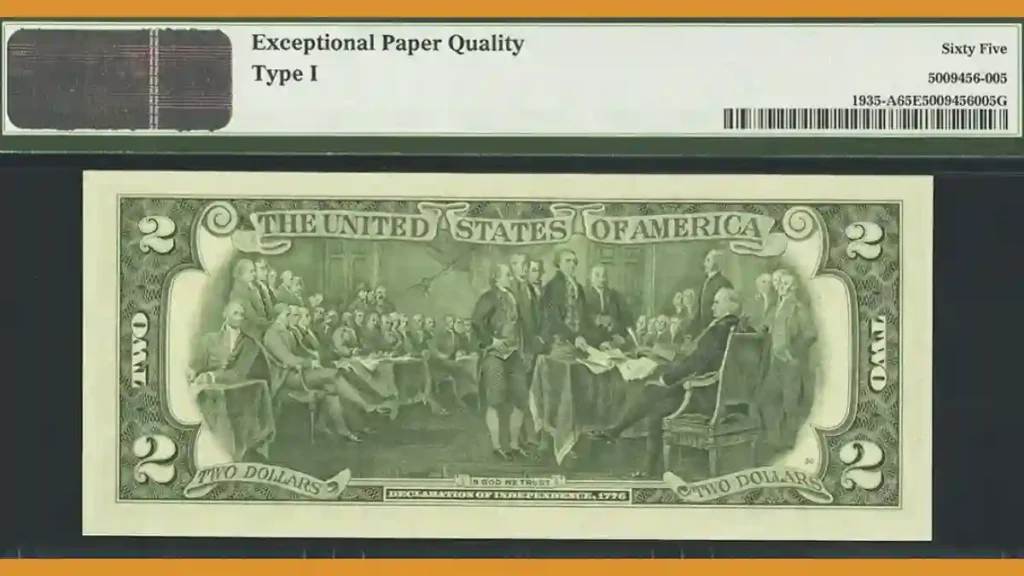
The area I want to show you is the bottom right of the back. That little number is called a backplate number. It’s an internal number used to track where the bill was located on a printing plate. These plates are big, and they wear out over time, so a BEP employee can look at that number and know exactly which location on a printing plate the bill came from.
Remember, I told you the back is the first print. Flip it to the front and everything looks normal for the second print. But the third and final print, the overprint, was inverted. It was printed upside down, which is a huge mistake. Not only that, it got through quality control. Oopsies. But hey, that mistake allowed someone to make $2,880 online.
5. Missing Back Print Error: $3,960
$3,960 for this 1976 $2 bill. First, I want to show you the centering. There are two things that allow your bank note to get a high grade.
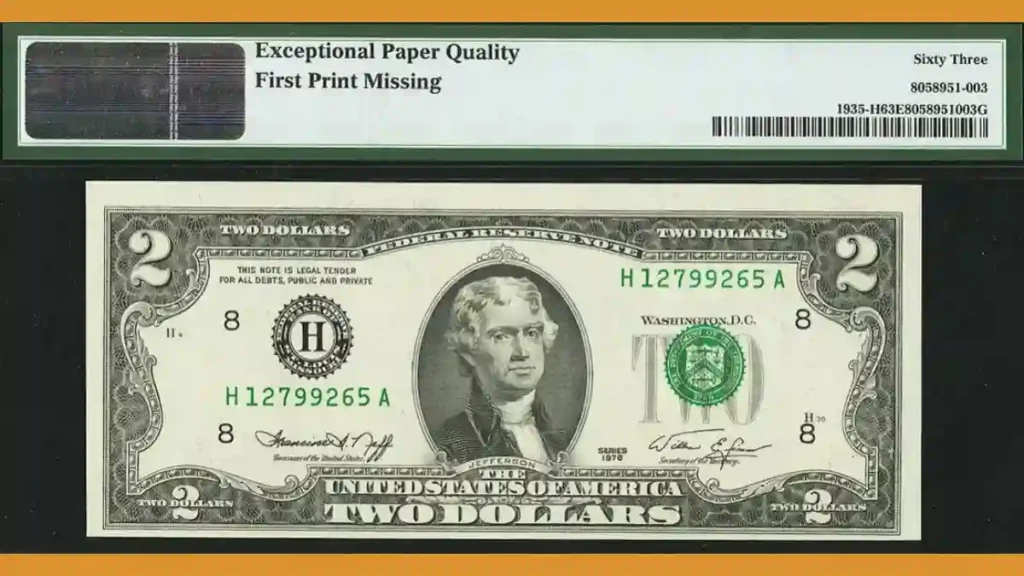
The first is making sure there isn’t a single fold on your bill. That means not a fold down the center and not a fold on a corner. If the fold clips the design or touches it in any way, the grade drops immediately. If your bill has no folds, you can get a 60 to 70, which is what you want.
The second is centering, which is the white margin around the bill. You can see the centering here is really bad. The worse your centering is, the lower your uncirculated grade will be. In this case, it got a 63.
As we recalled from earlier, the second and third prints on a $2 bill are on the front. When we flip it to the back, you can see the first print is missing.
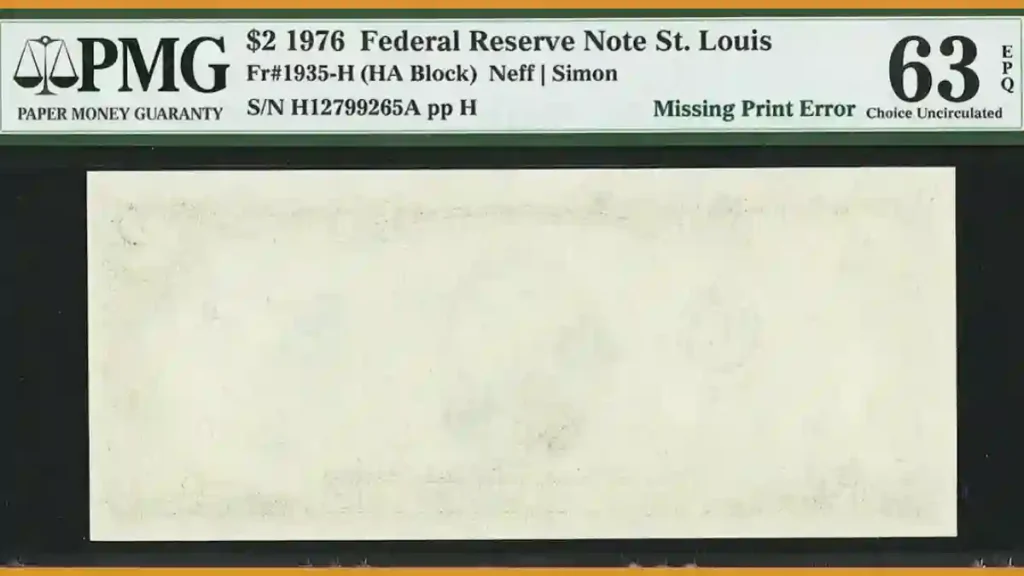
Now, be very careful, guys. I’ve seen countless people get scammed online. People watch a video like mine and say, “Oh, I can just get an eraser, erase the back of my bill, and sell my $2 bill for nearly $4,000.” That’s not always the case. Companies like PMG and PCGS are highly qualified experts that know how to detect alterations. They also have a money-back guarantee that what they put in the holder is genuine. So if you ever want to buy a bill like this, buy one that’s already graded, because you have the safety there. Never buy a raw note like this online. There’s a high probability someone is trying to scam you and just erased the back or bleached it out. So be careful. Nonetheless, 3,960 bucks for this missing print error.