I’ve helped collectors buy and sell millions in rare collectibles. The sale prices in this article are all backed by real data from top auction houses like Heritage.
I know what makes coins and currency valuable, and today I’ll break it down for you.
The 1965 Roosevelt Dime
Check this out, guys. We’re on this first coin here. This is a 1965 Roosevelt dime. This is a very important coin that you don’t want to miss, so pay close attention.

These coins are not typically on a 90% silver planchet, but this one was. This is what we call a 90% transitional alloy coin.
Enough with the mumbo jumbo. What do I got to look for on my 1965 coin to see if it’s rare?
Well, I’m glad you asked. What you’re going to want to do is take your 1965 coin and weigh it. This coin weighs 2.5 g.
Guys, did I mention this coin sold for $14,400? That is why you want to weigh all of your 1965 coins, to see if they were accidentally struck on a 90% silver planchet.
The 1951 Roosevelt Dime
Now, if you thought this coin was cool, just stay tuned. We’re going to go over some really, really cool coins. But once again, this coin sold for $14,400.

Check out this crazy toning happening on the coin. That coloration there will increase the value if it looks nice to the collector.
This coin graded very highly by a company called PCGS. It sold for $118,800. The coin is from 1951.
The 1968 No S Proof Dime
All right, this is when we step it up a bit to the major league. This coin sold for $40,800, so pay close attention.

Trust me, this can get a little complicated, but I’ll make it as simple as possible.
Proof vs. Non-Proof Coins
In 1968, you’ve got two different types of coins. You have a proof coin and a non-proof coin.
This is a proof coin that you’re looking at. Proof coins are made in a different manner than normally issued coins that you get in pocket change.
Proof coins have a very shiny, lustrous backdrop, like a mirror on the field of the coin.
Where the Value Comes In
So here it is. This proof coin should have an S mint mark above the date, but it does not.
The issue is there are a lot of these coins that look just like this with no mint mark, but they are not proof coins.
All 1968 proof coins should have an S mint mark. If you have a 1968 proof coin with no S mint mark, that is where the value really comes into play.
Here’s the issue. You’re going to come across a 1968 coin with no mint mark, and you’re going to think that it’s really rare and valuable, but it’s not. It must be a proof coin. That is the biggest takeaway.
We get tons of questions on this coin because it’s a little bit complicated. All you got to know is look at the difference here between a proof coin and a Mint State coin. There’s a clear difference.
You need to have a proof coin with no S mint mark. That is how you get a coin worth $40,800.
The 1999 Mule Error Coin
When you’re looking at the back of this Roosevelt dime, the first thing you’ll notice is obviously the color. It looks like a penny. This one’s over $138,000. That’s a lot of money.

Now, when you flip it over to the front, you’ll notice that this coin is a 1999 1 cent coin that was struck with an obverse die of a cent coin, muled with a Roosevelt dime.
What Does “Mule” Mean?
Mule just means two different things put together, like a mule is a horse and a donkey. That’s how you get a mule: by having a cent coin and a Roosevelt dime put together.
But if you come across one of these coins, you’ve hit the payday motherlode, because this bad boy sold for $138,000.
The 1975 No S Proof Dime
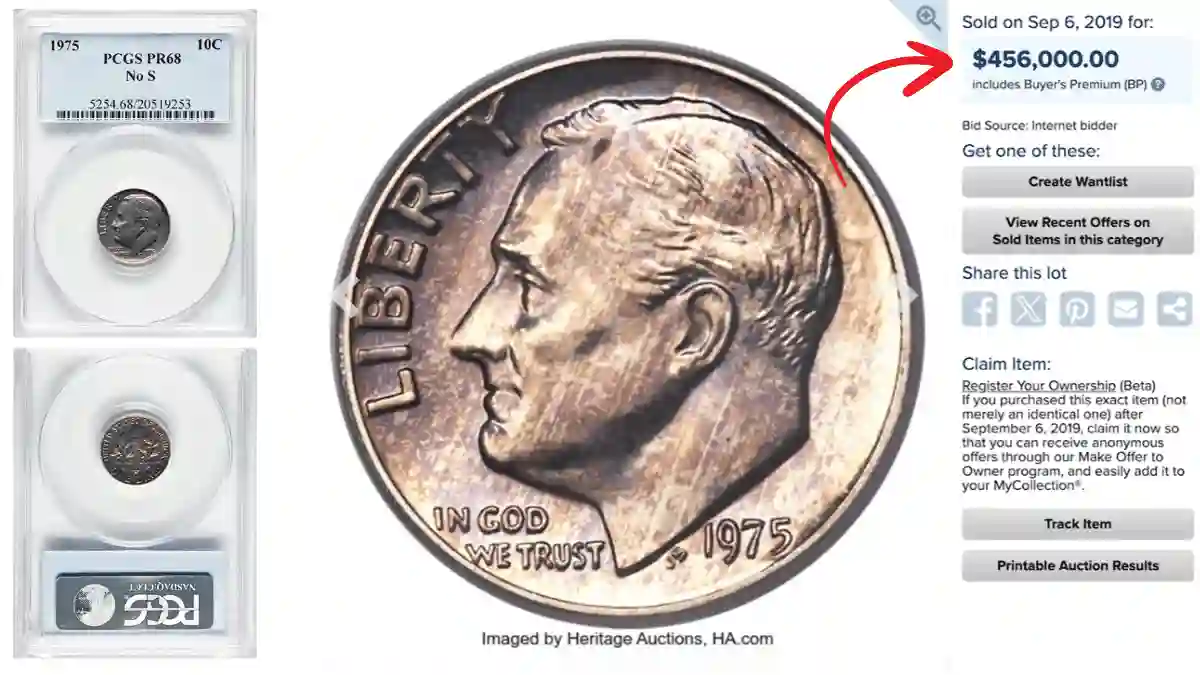
If you thought the previous coin was worth a lot, this one sold for $456,000. After this coin, I’m going to show you a really interesting thing that came up recently.

But I’ll keep this very simple, guys. I’m not going to fluff it around and waste anyone’s time.
Same Idea as the 1968
This beautiful coin, I mean, you can see the purple-gold coloration going on. It’s the same thing as the 1968. It is a proof coin that is missing an S mint mark.
I’m going to explain it one more time, very quickly, just so you clearly understand.
Philadelphia produced a lot of these coins. Philadelphia-issued coins will have no mint mark on the coin.
San Francisco also produced this coin as a proof coin, and there will be an S mint mark above the date.
Mint State coins and proof coins look very different. Proof coins should have an S mint mark. If you have a proof coin with no S mint mark, that is where the value lies. It is a mint error. It should have never happened.
The Sale Price
This is called a 1975 no S proof coin. Graded by PCGS at a Proof 68, it sold for $456,000. Nearly half a million.
Could you imagine coming across a coin like this? Well, the probability is pretty slim.